Home  |  About Us  |  Social Entrepreneurship Training  |  Social Venture Investment  |  Current Programs  Living Stories Job PositionsContact


Recent Projects


Since 2006, Global Grassroots has trained nearly 250 Rwandans who have designed 29 social projects benefiting marginalized women.  Each project has between 10 and 45 team members, and supports countless others within each community.  Following are recent examples: 

Meg Foundation School
Grant amount: $3200
Team size: 45 men & women
Social impact: 60 women & their families

 The Problem:  This team has identified women’s involvement in sex work, and in turn exposure to and lack of knowledge about HIV/AIDS as one of the greatest problems facing their community. In Kinamba, Kigali, many women and girls have been left widowed or orphaned from the genocide and have felt forced into prostitution with little to no education and skills to secure other jobs. One team-member states, “After talking to the women, we have helped them to decide to leave prostitution and change their lives, but they need skills training in order to be able to earn a living without prostitution.”

The Solution:  To help vulnerable women earn a sustainable living without exposing themselves to HIV/AIDS through prostitution, the MEG Foundation School plans to offer training in tailoring, workshops on HIV/AIDS prevention and reproductive health as well as literacy and English classes.   

Methods of Evaluation:   In year one, the MEG Foundation School will provide 60 prostitutes a sustainable and healthy alternative for themselves and their families. The goals of the project, measured through surveys, interviews and home visits, include that every student is able to make clothes on her own, that the hygiene and nutrition of the women improve, that they understand the consequences of HIV/AIDS and how to prevent it by using condoms, that women understand their options for contraception, and that the participants learn to read and write. 

Invincible Vision 20/20
Grant amount: $2800
Team size: 8 men & women
Social impact: 1027 women

The Problem: In the Byimana Sector of rural Kigali, 62.4% of the female population is illiterate.  Despite the District Government literacy program, the 8 members of the Invincible Vision 20/20 project team have found that local women are still lacking adequate reading and writing skills to inform their knowledge of laws that protect them and their families.  Without these skills, these women are essentially excluded from development and are unable to participate fully in society. 

The Solution: To provide training for these women in reading, writing and basic math skills so that they feel empowered to become active participants in society and take charge of their own development. As a creative resourcing strategy to cover their ongoing operating costs, the team has encouraged local school children and their participants to collect rocks, broken bricks and firewood from the side of the road.  After about one week, the team collects enough to sell a truckload to construction companies.

Methods of Evaluation:  Invincible Vision 20/20 will train 1,270 women who are not benefiting from the District Government literacy program.  The team will use examinations and surveys to measure its progress in teaching women to read, write, open bank accounts, perform financial tasks on their own, participate in local government and develop the courage to approach local authorities and police to report violations of the rights of other women. With literacy and basic mathematical instruction, these women will be better equipped to bring change for the future generations of Byimana.  

ABANYAMURAVA “Hard Worker”
Grant amount: $2600
Team size: 10 women
Social impact: 500-600 people

The Problem:  In a community on the outskirts of mountainous Kigali, a team of ten women led by HACIMANA Seraphine have been particularly troubled by the long journey they must embark upon each day to collect water down a long hill to a dirty creek bed. In addition to the disease and poor hygiene associated with poor water access, many of those who were left physically disabled or HIV positive from the genocide are unable to collect for their daily needs.  Instead, they are forced to turn to local men with bicycle access, some of whom have begun exploiting them for sex in return for water delivery. 

The Solution:  ABANYAMURAVA has designed a water tank project in their remote community that will serve 60 households (with an average number of children of 6-10).  This social project will also:

  • donate 10 jerry cans of water per tank to five orphan headed households,

  • pay the school fees for five children who are AIDS orphans or genocide orphans and

  • buy annual health insurance for 15 women and their families

By providing clean and affordable water to their community members, ABANYAMURAVA will be able to reduce the prevalence of water related disease as well as diminish the vulnerability of women who are unable to make the long journey to what was previously, the only other water source. 

Methods of Evaluation:  The project has arranged partnership with the local clinic, church and authorities to properly evaluate their impact.  They are also planning on conducting regular meetings with families within the community to confirm that the project has improved their health and reduced any former reliance on others for access to water. 

HARANIRA UBUZIMA  “Work For Life”
Grant Amount: $1232
Team size: 16 women
Social impact: 1750 - 2250 people

The Problem:   Under the leadership of KABAGABIRE Francine, 16 women have decided to address the issue of limited and unreliable access to clean water in their community. The extremely limited capacity results in hours of waiting for one's daily supply of water, causing job tardiness and lack of school attendance.  While unpredictable water access affects all community members, the HARANIRA UBUZIMA group identified widow and orphan-headed households as the most vulnerable groups bearing the brunt of this problem.  

The Solution:    To help address these debilitating issues for vulnerable members within the community, HARANIRA UBUZIMA has developed a socially motivated venture.  These 16 women are installing a water tank on land donated to them by their local church.  Here they will tap into the local piping system, gaining access to clean and more readily available water for 250 local households.  The group will use proceeds to provide:

  • two jerry cans of water for five vulnerable households per day,

  • soap, cleaning services, and cultivation guidance for five vulnerable households per week,

  • 10 kilos of rice for five households per month

  • school fees for five orphans,

  • annual health insurance for five families (each with six members) and

  • rent for eight association and eight non-association members.

Methods of Evaluation:   In order to ensure that HARANIRA UBUZIMA is making a positive social impact in their community, interviews and testimonies will be collected every two months following project implementation to gather data about the project’s impact for the local clinic, school, community and group members.

   
NEW!   February 2008 Project Update:
Project Leader HACIMANA Seraphine and team have reduced the vulnerability of their neighbors

By Gillian Porcella - Team ABANYAMURAVA's First Water Delivery

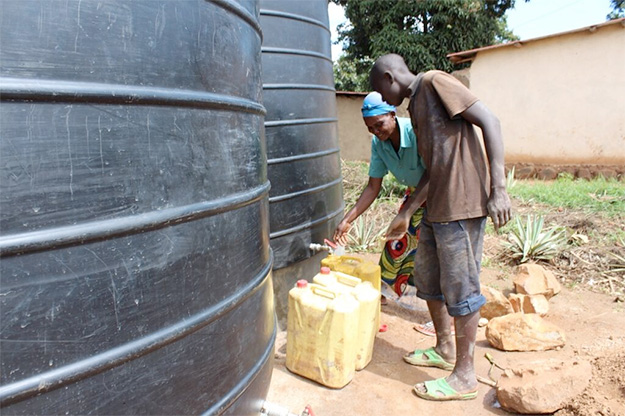
During Global Grassroots' most recent trip to Rwanda in January, we visited Gahanga, a community on the outskirts of mountainous Kigali where project leader HACIMANA Seraphine and the ABANYAMURAVA team gathered their neighbors to speak with us about their first water delivery earlier that week.

Gahanga was formerly forced to rely upon a dirty water source located at the bottom of the valley. Before attending Global Grassroots training, Seraphine noticed that not only was the two-hour water collection too time intensive for her busy community, it often left those physically disabled or infected with HIV from the genocide relying on men with bicycles to collect water in exchange for money or sex. After graduating from our training, Seraphine and her fellow team members realized that they had the power to combat this issue head-on.

This dedicated group of women designed a water tank project that could reach over 60 households, including Gahanga’s most vulnerable neighbors by providing clean, reliable and affordable water. However, the quickly-rising price of cement and professional labor meant that our original Global Grassroots grant would no longer cover the construction of the tank foundation. Instead of abandoning their project, ABANYAMURAVA put their newly-learned creative resourcing skills to work and decided to sacrifice their time and wages to come together and build the foundation themselves. They were then able to rely upon the newly designed rain-water collectors during rainy season, and saved what was necessary so that they could ensure their first water delivery once dry season began.

During our visit, community members shared with us that they were incredibly grateful for the water tank. It meant that they no longer had to forfeit part of their busy day to make the arduous journey down the valley to only return with dirty water. Children were now on-time for school and mothers had enough water to cook for their families throughout the day. We also learned that people were now able to clean their houses and themselves much more often, which they told us greatly improved their quality of everyday life. We were especially pleased to hear that with the new tank, many women were no longer sexually exploited because of their need for water.

What was most thrilling to see, was the pride exhibited by these women. With the help of Global Grassroots, these community members learned to properly diagnose an issue and found the solution to promote social change on their own. Seraphine, who is married with seven children at the age of 38, has been approached by several individuals requesting that she share her skills and guidance so that they too may combat issues within their own communities. These “hard workers” have truly shown us that they are willing to sacrifice in the spirit of improving their community.